There are stories that historical textbooks omit — stories of ordinary people caught in the wind of epochal shifts. The romance of Francesco Izzo and Caterina Riccio is one of these: a soldier who chose loyalty to his oath, a girl who chose loyalty to her heart. Both paid an extremely high price. Both, in their own ways, held out until the end. (Written by local author Nicola Angelo Tinessa)
Two Souls Born on the Same Day
April 12, 1839 · April 12, 1841A bizarre twist of fate bound these two young souls even before they met: Francesco Izzo was born on April 12, 1839, the son of Pietro, a farmer in the Latonuovo quarter. Caterina Riccio was born exactly two years later, on the very same day — April 12, 1841 — in the Santo Spirito district on the opposite side of the hill. It was as if something, from the very beginning, wanted to intertwine their paths.
Francesco grew up in Latonuovo, split between agricultural labor and the sense of duty instilled by his family. Caterina, as an eighteen-year-old, tended to domestic chores in Santo Spirito. They were two youngsters like many others in mid-19th-century Montesarchio — until history came knocking at their door.
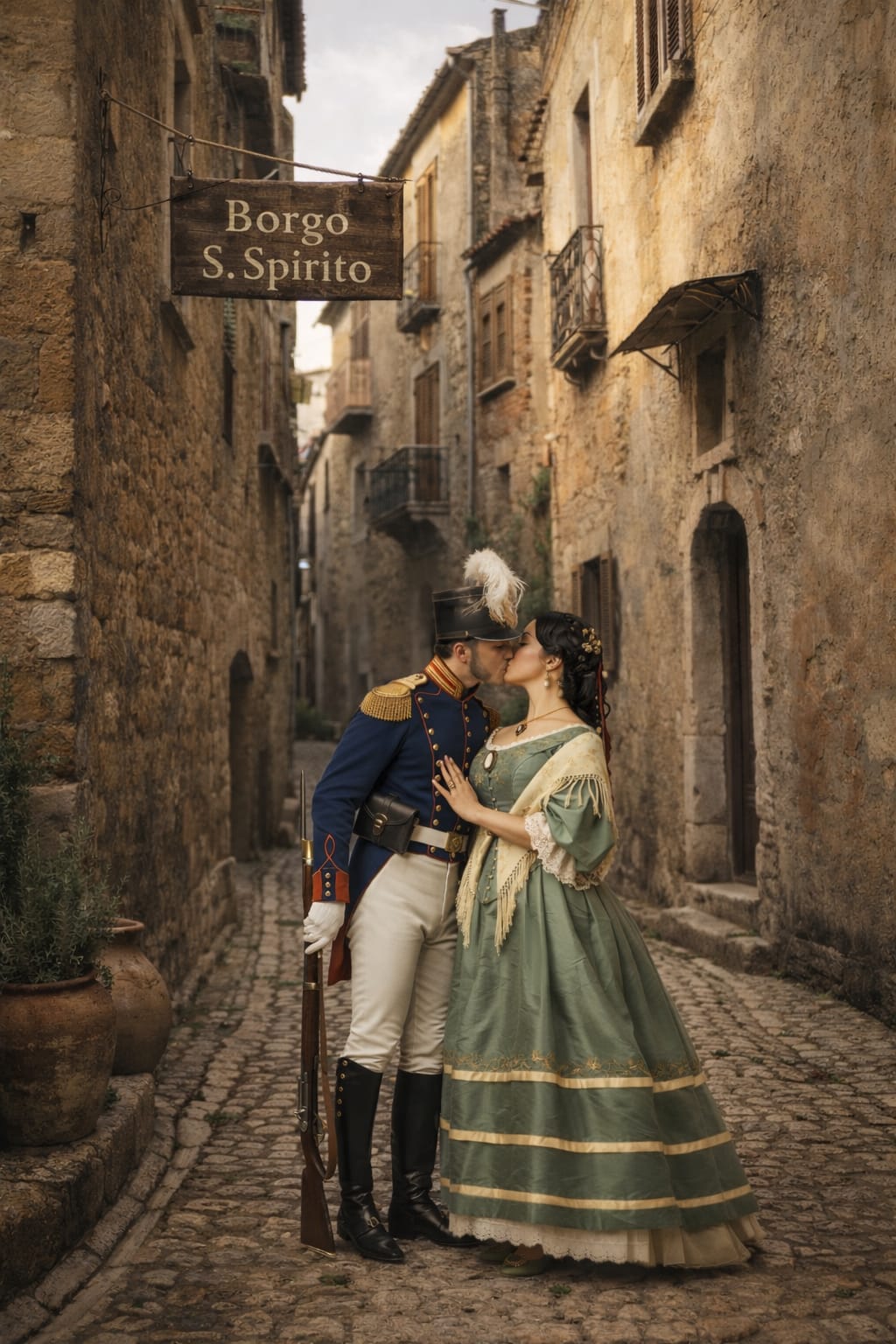
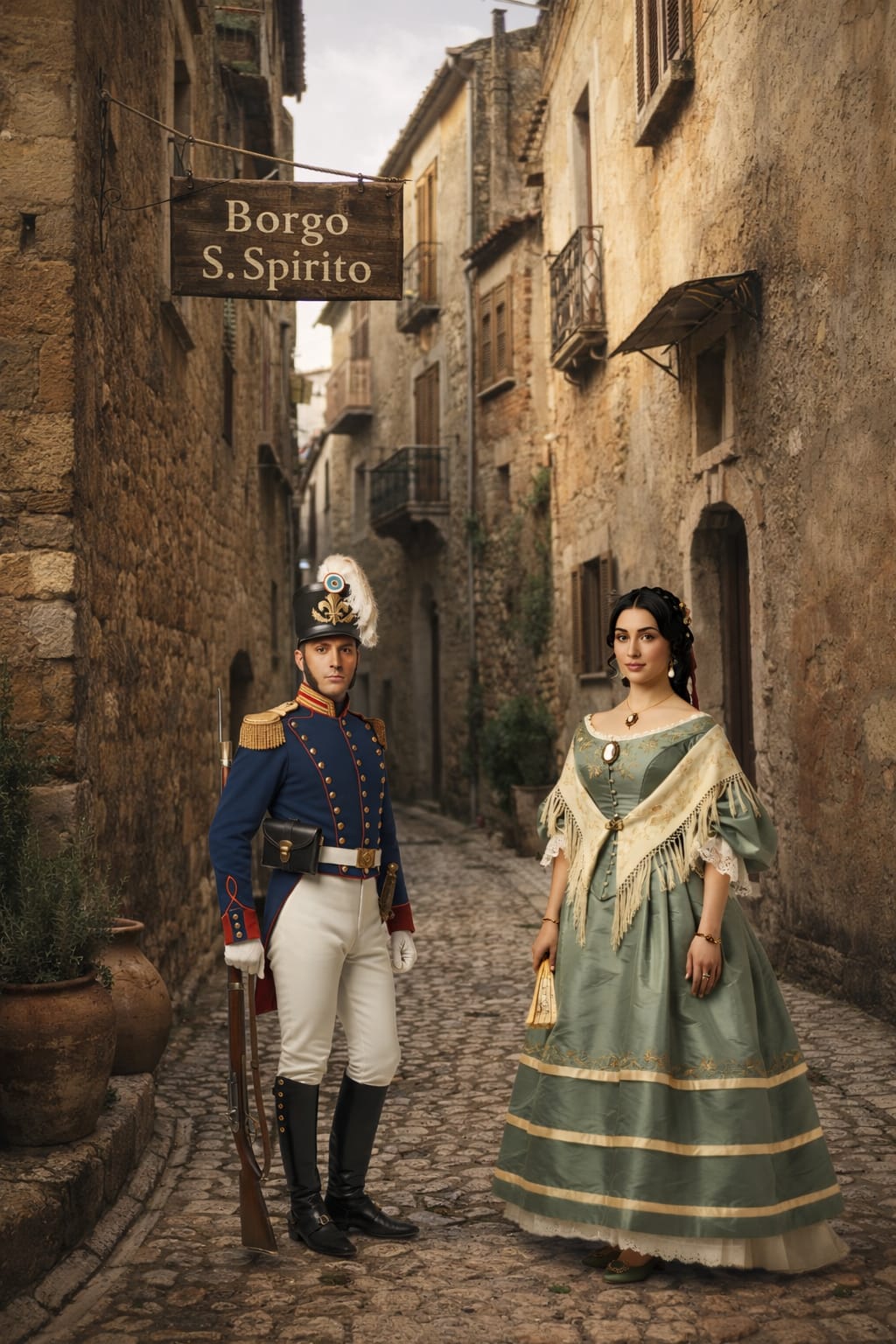
To the left, Latonuovo, the home of Francesco · To the right, Santo Spirito, the home of Caterina
Francesco Izzo
Born on April 12, 1839 in Latonuovo. Son of Pietro, a sharecropper. Bourbon soldier, then a hunted brigand. Died on May 31, 1865, on the slopes of Mount Taburno.
Caterina Riccio
Born on April 12, 1841 in Santo Spirito. Sentenced to forced exile on the Island of Giglio in 1863, imprisoned in Benevento in 1865. She survived the grief. She survived it all.
When History Divided the Heart
1861 · The Fall of the Bourbon KingdomUp until the Unification of Italy, Francesco Izzo was a regular soldier: a draftee of the Kingdom of the Two Sicilies who had sworn allegiance to the King of Naples. Then, in 1861, his world collapsed. The old kingdom was abolished, annexed into the new Italian state, and Bourbon soldiers were ordered to enlist in the newly formed national army.
Francesco refused the call. This was not merely modern political rebellion — it was something older and deeper: loyalty to his sworn oath. He had bound himself to the Neapolitan Crown, and that promise did not dissolve with a decree.
He was thus labeled a draft evader by the administrative bureaucracy of the time. As his resistance turned into open survival, he became an outlaw — a "brigand" hunted by the modern kingdom's troops throughout the rough valleys and forests surrounding Montesarchio.
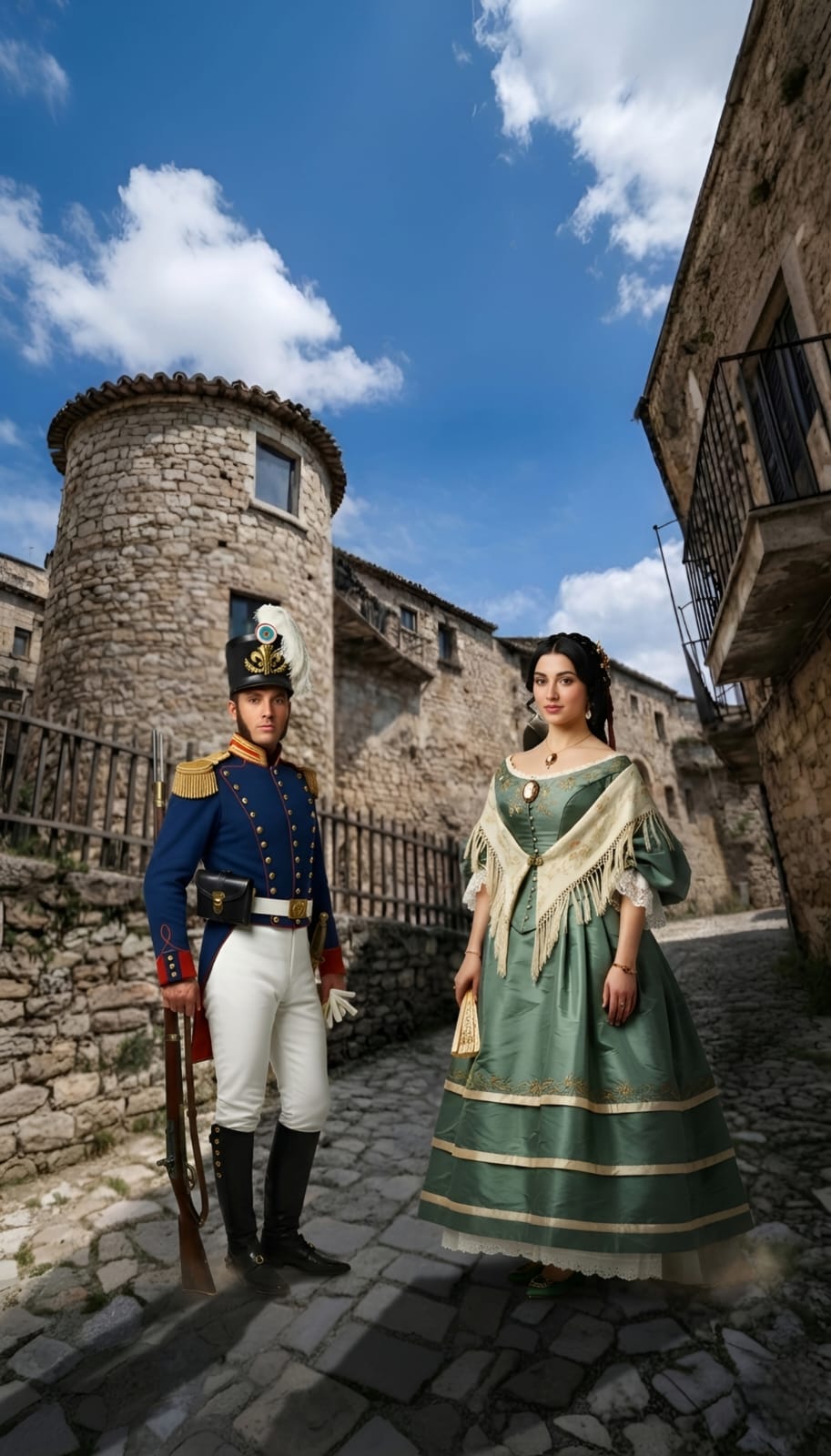
The places they lived, met, and loved · Montesarchio and the slopes of Mount Taburno
She Followed Her Heart
1861 – 1863 · Loyalty and SacrificeCaterina knew. She knew what became of Francesco, and she knew the immense risks. Yet she chose to love him, to shelter him, and to help him evade the military units patrolling the countryside of the Caudine Samnium. She was what the laws of the time termed a manutengola (accomplice) — a word that turned natural devotion into a criminal offense.
Her crime was simply loving a man the state had declared an enemy of the land. For this, she paid dearly.
Returned from exile and legally warned to maintain good behavior, she immediately resumed her relations with the brigand Francesco Izzo, her lover.
— Judicial files from the Court of Benevento, 1865On October 23, 1863, Caterina was sentenced to one year of forced exile on the Island of Giglio — a remote island in the Tyrrhenian Sea, hundreds of miles away from her home. On November 2, she was escorted onto the island, far from everything she knew.
The plaque on the wall of the Chapel of Saint Anthony in the cemetery of Montesarchio
The Longest Year
November 1863 – December 1864Francesco watched helplessly as his beloved was taken away. A hunted rebel could do nothing to stop the gendarmerie of the new kingdom, nor could he follow her across the sea. He remained in the mountains, alone, leading a fugitive existence among the crags of Taburno.
When Caterina finally returned from the Island of Giglio after serving her full sentence, the two reunited immediately. But the authorities did not relent. On December 20, 1864, she was placed under strict surveillance again in an attempt to sever their tie once and for all.
Forced exile (domicilio coatto) was a policing measure used without an open trial. It forced individuals deemed suspect or associated with rebels to reside in remote coastal islands. It was heavily used to disrupt the support networks of southern dissidents.
Caterina Riccio is sentenced to one year of exile on the Island of Giglio.
She departs for the island. Francesco watches her leave from afar, powerless.
Caterina returns to Montesarchio and immediately seeks out Francesco.
New police alerts are issued against Caterina to prevent any communication.
Caterina is arrested and taken to the prison of Benevento awaiting trial.
Francesco Izzo's body is found in the Tuoro del Faro area. His flight is over.
Caterina is released after charges are dropped due to lack of evidence, only to learn of Francesco's death.
The Circle Closes
May – June 1865On May 2, 1865, Caterina was arrested once more and transported to the jail of Benevento. Inside those stone walls, she spent the final weeks of their love story, entirely unaware of what was unfolding in the hills.
Francesco, meanwhile, had moved from his shelter in Latonuovo to hide closer to the slopes of Mount Taburno. But the police informants had already completed their betrayal.
On May 31, 1865, in a small mountain valley called Tuoro del Faro, soldiers discovered the body of Francesco Izzo. He was twenty-six years old. His long evasion had ended.
Ten days later, on June 10, 1865, Caterina was released due to a lack of evidence. She walked home to Montesarchio, only to receive the tragic news of Francesco's death.
Return and Silence
Summer 1865 · The Burden of SurvivalAt first bewildered, with the listless gaze of one who has not fully comprehended the words, she grew incredulous; then her pale face turned completely ashen. Sobs shook her entire body. She lost all track of time in that state of absolute grief.
— Historic local accountFor many days Caterina remained shut inside her home, refusing food. She wept for her fallen lover with the same fierce obstinacy with which she had endured exile, prison, and isolation.
She only left her house months later. By the following spring, she returned to work in the fields, but her youth was gone forever, taken not by age, but by history. Her face bore a quiet, permanent sadness.
She never spoke his name again. For the rest of her life, she kept her grief entirely to herself. Their dream of love ended just as the ancient kingdom they had remained loyal to was dismantled.
The Memory That Remains
Since 1865Today, in the cemetery of Montesarchio, on the wall of the Chapel of Saint Anthony, a modest plaque honors this tragic love. It is not an epic war memorial, but a quiet tribute to ordinary people who loved each other through extraordinary adversity.
✦ In Memoriam ✦
Francesco Izzo · Caterina Riccio
Both born on April 12: he in 1839, she in 1841.
They lived on opposite sides of the Montesarchio hill.
Counted together by love, pulled apart by history.
Endlessly remembered.
Cemetery of Montesarchio · Chapel of Saint Anthony
Their story was detailed in the historical essay Francesco and Caterina – Unification of Italy and Brigandage, adapted into an emotive local play during the festival Giorni al Borgo in 2013, and turned into an educational short film in 2014.
Post-Unification Brigandage in Sannio
1861 – 1870 · The Forgotten WarThe story of Francesco and Caterina cannot be understood without its broader context. After the Unification of Italy in 1861, the southern regions became the stage for a bloody civil war — characterized as "brigandage" by northern authorities, but representing a complex social resistance to the local population.
Thousands of soldiers who, like Francesco Izzo, felt bound by their loyalty to the King of Naples, refused to serve the new state. Many took to the rugged woods of Mount Taburno as outlaws, fighting a desperate war of survival they had never sought.
The Italian government responded with the harsh Pica Law of 1863, which set up military courts to execute brigands and exile their accomplices. This fierce repression left profound scars across the South.
Between 1861 and 1863, over 5,200 dissidents were killed or captured in the southern provinces. Tens of thousands of people like Caterina faced trial or police sanctions for supporting them. It was a silent war that was omitted from official textbooks for generations.